


Hedging Interest Rate Risk – Would it have paid off for Swiss Banks?
Learning from the Last Interest Rate Cycle – Preparing for the Next
The current geopolitical tensions surrounding the Iran crisis have already led to a noticeable increase in long-term interest rates in major currencies. This brings a scenario back into focus: central banks tightening monetary policy to fight inflation, which may also raise interest rates in Switzerland.
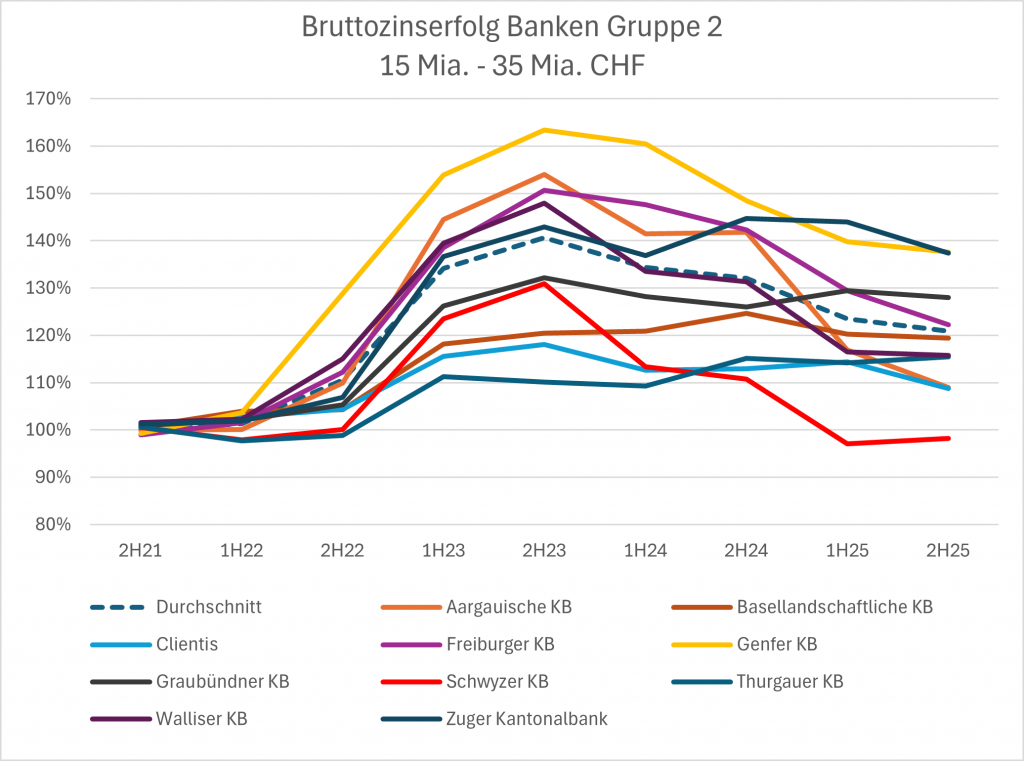
Against this background, Orbit36 examined how Swiss domestic banks managed through the last interest rate cycle 2021–2025.
The banks in our sample – mostly cantonal and regional banks – performed very differently during this period. While some institutions benefited only temporarily from rising rates, others managed to sustain elevated earnings levels over a longer time horizon.
What explains this divergence?
Balance sheet structure is a key factor, but hedging strategies for interest rate risk can also play an important role. Hedging practices among Swiss banks vary significantly. While some institutions apply sophisticated hedging strategies, others do not hedge at all.
Which hedging strategy performed best
To better understand how different hedging strategies influenced interest income in the period 2021-2025, we performed model calculations and assessed commonly used strategies for three hypothetical banks with different balance sheet structures, assuming parameters typical for banks active in the Swiss loan and deposit market.
The results confirm that partial hedging of ΔEVE was costly during the negative rate regime but became beneficial following the sharp increase in rates. However, this effect proved to be only temporary.
The best-performing strategy was a systematic hedging approach covering all assets and liabilities, combined with defining and implementing a target duration for shareholders’ equity.
The full paper (in German) is available for download below.
Please reach out to us if you would like to discuss what an optimal hedging strategy could look like for your bank.